
In the sprawling, neon-lit heart of New York City, the Avengers Tower stood as a beacon of hope, a gleaming testament to the heroes who safeguarded the world. Inside, the team gathered in the war room, their faces etched with tension. The holographic display flickered, projecting images of cataclysmic battles, cosmic threats, and the looming specter of Doctor Victor von Doom, whose machinations had recently toppled entire nations.
But today, the conversation wasn’t about Doom. It was about one of their own—Robert Reynolds, the Sentry, the man with the power of a million exploding suns. Captain America, his shield resting against the table, leaning forward, his voice steady but grave. “We’ve faced gods, tyrants, and cosmic entities, but Bob… he’s something else. If he loses control again, we might be unable to stop him. “Iron Man, Tony Stark, tapped his fingers on the table, his suit’s HUD flickering in his peripheral vision.
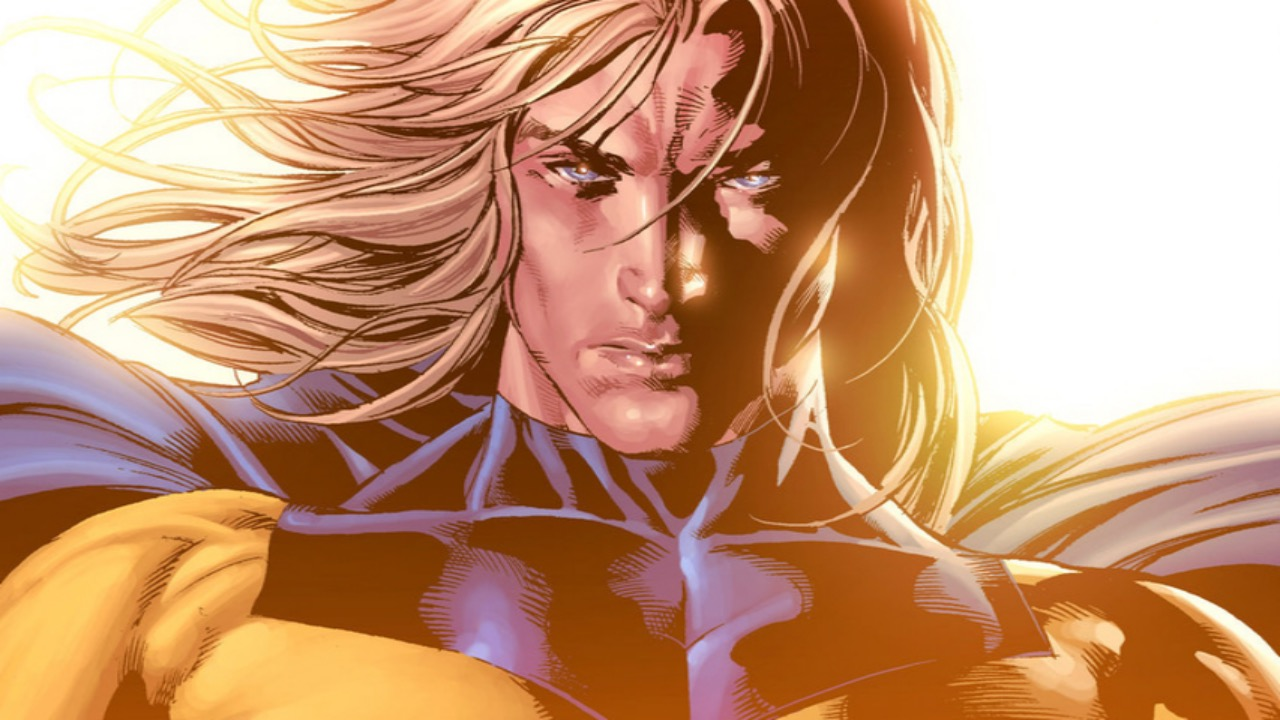
“You’re not wrong, Steve. The Sentry’s power is off the charts—stronger than Thor, faster than Quicksilver, and a psyche more fragile than a house of cards in a windstorm. If he snaps, we’re not just talking collateral damage. We’re talking extinction-level event. “The room fell silent. The Avengers had faced countless threats, but the idea of one of their own becoming a bigger danger than Doctor Doom sent a chill through even the most battle-hardened among them. The Sentry wasn’t just powerful; he was a walking paradox, a hero and a potential apocalypse wrapped in a golden cape.
Robert Reynolds sat alone on the tower’s roof, his golden suit glinting under the moonlight. His eyes, usually radiant with cosmic energy, were clouded with doubt. The Void, his dark alter ego, whispered in the recesses of his mind, a constant reminder of the chaos he could unleash. Once, years ago, he’d lost control, and entire cities had paid the price. The Avengers had forgiven him, but forgiveness didn’t erase memory. He could feel their wary glances, their unspoken fears. They trusted him to save the day, but didn’t trust him to stay sane. The new Avengers movie, set to hit theaters in 2026, had already sparked fan speculation. Leaked set photos showed the team facing off against a masked figure in Latverian armor—Doctor Doom.
But rumors swirled of a deeper, more personal threat that would tear the Avengers apart from within. Robert had overheard Tony and Bruce Banner discussing it hushedly: What if the real danger isn’t Doom? What if it’s Bob? The Sentry’s origin was a tragedy wrapped in a miracle. A scrawny kid who’d stumbled upon a secret super-soldier serum, Robert had been transformed into a godlike being. Strength, speed, flight, energy manipulation—he had it all. But the serum had a price. It fractured his mind, birthing the Void, a malevolent entity that thrived on destruction. Robert had kept it at bay for years, but the effort was like holding back a tidal wave with a paper towel. Every battle, every moment of stress, pushed him closer to the edge.
The Avengers’ concerns weren’t theoretical. Months earlier, during a skirmish with a rogue Kree warlord, the Sentry had unleashed a blast that vaporized an entire fleet—and half a mountain range. The team had cheered for the victory, but Natasha Romanoff, the pragmatist, had noticed the flicker of darkness in his eyes.
“He enjoyed it a little too much,” she’d whispered to Clint Barton. The Void wasn’t just a separate entity but a part of Robert, a twisted reflection of his desires. Now, with Doctor Doom’s shadow looming, the Avengers were on edge. Doom had recently united a coalition of villains—Loki, Kang, and a mysterious figure known only as the Maker—into a cabal bent on reshaping reality. The team needed the Sentry’s power to counter them, but at what cost? Thor, who’d faced cosmic threats across the Nine Realms, put it bluntly.”
The Sentry is a star that could burn us all to ash. “The turning point came during a mission in Latveria. Doom had unleashed a reality-warping device, a machine powered by stolen Asgardian runes and Skrull technology. The Avengers stormed his fortress, only to find themselves outmatched. Doom’s intellect had anticipated their every move, his armor deflecting even Mjolnir’s strikes. As the team faltered, the Sentry stepped forward, his body glowing with the radiance of a supernova. “Stay back,” he growled, his voice tinged with something primal. The Avengers hesitated, sensing the shift. Robert’s eyes burned not with heroism, but with rage.
He tore through Doom’s defenses, shattering the device in a blast that shook the continent. But he didn’t stop there. The Void surged forward, a shadowy tendril lashing out from his form, leveling entire city blocks. Civilians screamed, and the Avengers scrambled to contain the fallout. “Bob, stand down!” Captain America shouted, hurling his shield to block a stray energy wave. But the Sentry didn’t hear him. The Void was in control now, its laughter echoing across the battlefield. Thor tackled him, their clash sending shockwaves that cracked the earth. It took the combined efforts of Iron Man’s nanotech, Scarlet Witch’s hexes, and Doctor Strange’s mystic barriers to subdue him. When the dust settled, Robert lay unconscious, his golden aura dimmed. Doom had escaped, and Latveria was in ruins.
Back at the tower, the Avengers held an emergency meeting. The holographic display showed news feeds: “Sentry Rampage Devastates Latveria,” “Is the Golden Guardian a Hero or a Menace?” The public, once enamored with the Sentry’s godlike presence, was turning against him. Social media buzzed with fear, with some calling for his banishment to the Negative Zone. The 2026 movie’s narrative seemed eerily prescient—had the writers known something the public didn’t?
“We can’t keep pretending he’s stable,” Natasha said, her voice cutting through the tension. “He’s a liability. If Doom manipulates him, or if the Void takes over again, we’re done.”Tony, ever the optimist, countered, “We’ve got tech, magic, and muscle. We can contain him. Bruce, you’ve been working on that serum dampener, right?
“Bruce Banner, adjusting his glasses, frowned. “It’s experimental. It might suppress his powers, but it could also destabilize him further. We’re playing with fire.”Carol Danvers, Captain Marvel, spoke up. “I’ve fought across galaxies, and I’ve never seen power like his. But it’s not just about power. It’s about control. If he can’t trust himself, how can we? “The room turned to Robert, who’d been allowed to sit in, his hands clasped tightly, his face pale. “I’m trying,” he said, his voice barely above a whisper. “Every day, I fight it. The Void… It’s me, but it’s not. I don’t want to hurt anyone. “Steve placed a hand on his shoulder. “We know, Bob. But we need a plan. If you lose control again, we have to be ready.”
The plan was drastic: a containment protocol dubbed “Solar Eclipse.” It involved a combination of Stark tech, Asgardian runes, and Strange’s sorcery to neutralize the Sentry’s powers in an emergency. But the real challenge was psychological. Charles Xavier, called in as a consultant, warned that the Void wasn’t just a separate entity—it was Robert’s repressed fears, his guilt, his anger. “To defeat the Void,” Xavier said, “Robert must confront himself. “As the 2026 movie’s release approached, leaked trailers hinted at a climactic battle where the Avengers faced not just Doom, but a corrupted Sentry, his golden form wreathed in shadow.
Fans speculated wildly: Was this Marvel’s boldest move yet, turning a hero into the ultimate villain? The comics had toyed with the idea before, but the MCU seemed poised to take it further. In the weeks that followed, Robert underwent intense therapy with Xavier, delving into the trauma of his past, the lives lost, and the cities destroyed. But the Void grew stronger, feeding on his doubt. One night, alone in his quarters, Robert stared into a mirror, his reflection twisting into a grinning, shadow-cloaked version of himself. “You can’t lock me away forever,” the Void hissed. “You’re not a hero. You’re a bomb waiting to go off.”
The final straw came during a confrontation with Doom’s cabal. The Maker, revealed to be a twisted version of Reed Richards from another reality, had devised a psychic amplifier to exploit the Sentry’s instability. As the Avengers battled in the ruins of a shattered Manhattan, the device activated, flooding Robert’s mind with the Void’s influence. His screams echoed as he transformed, his golden light turning black, his eyes blazing with malice. The Avengers fought valiantly, but the Void-Sentry was unstoppable. Buildings crumbled, skies darkened, and even Doom, watching from afar, seemed unnerved by the chaos he’d unleashed. “Fascinating,” he murmured, “but perhaps I’ve overestimated my control.
“In a desperate gambit, Scarlet Witch reached into Robert’s mind, linking with Xavier’s telepathy. Together, they showed him visions of the lives he’d saved, the hope he’d inspired. “You’re more than the Void,” Wanda whispered. “You’re Robert Reynolds. You’re the Sentry. “With a cry that shook the heavens, Robert wrested control, expelling the Void in a burst of golden light. The effort left him comatose, his fate uncertain. The Avengers, battered but alive, stood over him, their faces a mix of relief and dread. Doom had been thwarted, but the cost was clear: the Sentry was a hero, but his dark secret made him a threat unlike any other.
As the 2026 movie’s premiere loomed, fans would see a story of heroism, betrayal, and redemption—a tale where the greatest danger wasn’t a tyrant in a mask, but the darkness within one of their own. The Sentry’s power was unmatched, but so was his fragility. And in a world of gods and monsters, that made him more dangerous than Doctor Doom could ever hope to be.



