
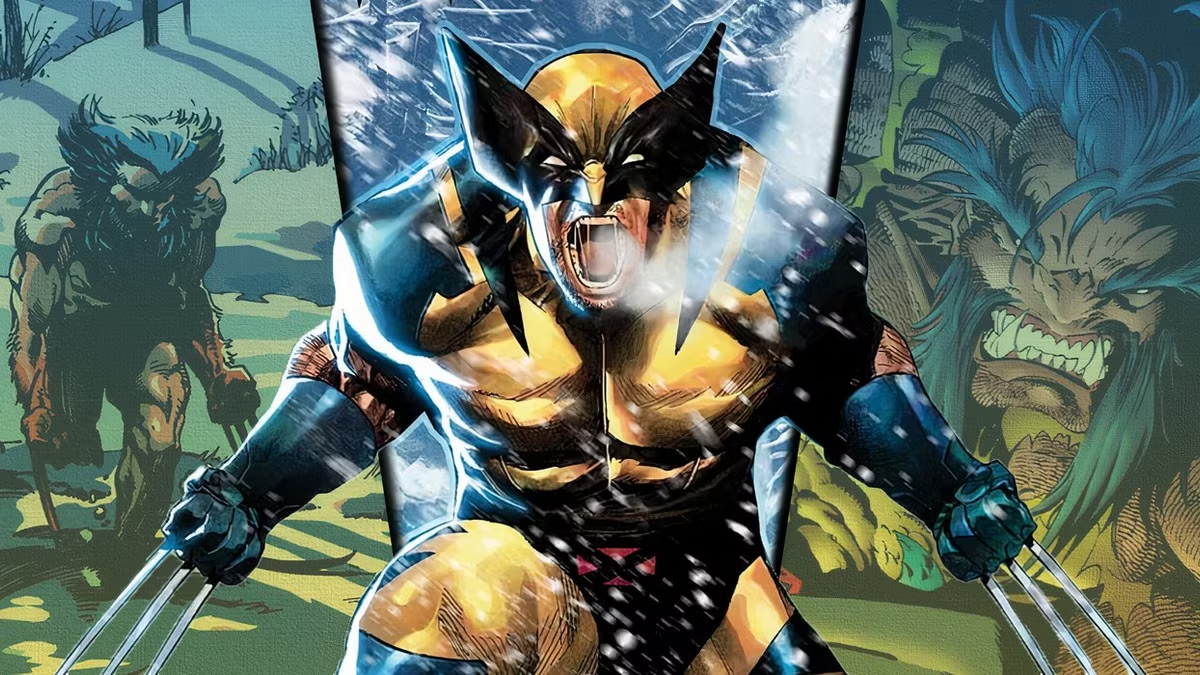
There is a conversation that has quietly haunted the margins of Marvel Comics fandom for decades — one that most fans never quite put into words, yet feel instinctively every time Logan pops his claws and snarls under a full moon. It is a simple but provocative question: Was Wolverine always meant to be a werewolf?
Not in a literal, folkloric sense. Not in the way of dusty Gothic horror novels or old black-and-white Universal monster films. But in terms of his powers, his psychology, his mythology, and his raw symbolic DNA. Everything about the character that Marvel built into one of its most enduring icons maps, almost perfectly, onto the archetype of the lycanthrope. Wolverine is, by nearly every definition that matters, a werewolf wearing the mask of a different animal. And the more closely you examine the character, the more you begin to wonder whether Marvel didn’t always know it, too.
The Beast Behind the Name
The wolverine, the actual animal, is a remarkably obscure creature to hang a superhero identity on. It is a solitary, stocky mustelid native to the cold wilderness of Canada and the northern United States: fierce, yes, but not glamorous, not mythologically charged, not the stuff of legend. The choice was deliberately odd. Writers Len Wein and John Romita Sr. wanted a Canadian connection, something rough and regional. The result was a name that, while distinctive, carries almost none of the symbolic weight that the character himself was eventually given.
Now consider what Wolverine actually is. He possesses highly advanced self-healing abilities, a significantly prolonged lifespan, animal-keen senses, and retractable claws. He is commonly depicted as a gruff loner susceptible to animalistic “berserker rages” who struggles to reconcile his humanity with his wild nature. That sentence could have been pulled directly from any introductory text on lycanthropy mythology. The healing factor that allows him to survive wounds that would kill any other man? Classic werewolf regeneration. The feral senses, the ability to track enemies by scent alone, to hear beyond normal human range, to navigate darkness like a predator? These are the gifts of the wolf. The retractable claws, extensions of bone that emerge when Logan is pushed to his limits? Even the physical mechanics mirror the transformation mythology: the body reshaping itself under pressure, extending and becoming something more dangerous than human.
Wolverine is a natural-born fighter, and one of his key characteristics is his struggle to maintain his humanity and reconcile it with his wild, animalistic nature. This internal conflict — the beast straining against the man — is not the story of a wolverine. Wolverines do not dream of humanity. They do not grieve for the civilized version of themselves. That tension, the very heart of Wolverine’s character arc across fifty years of storytelling, is the tension of the werewolf myth. It is the oldest horror of lycanthropy: not that the wolf is terrifying, but that you become the wolf, and some part of you loves it.
The Berserker Transformation
Consider the Berserker Rage. Berserker Rage is Wolverine’s tendency to turn into a complete animal. The phase is a state of heightened feral aggression and primal instincts that he sometimes enters during intense battles. While under the influence of Berserker Fury, Wolverine loses himself completely to that rage, becomes more reckless and brutal, and relents in combat.
This is a transformation. It may not involve a physical reshaping of bone and sinew under moonlight, but, functionally, psychologically, and narratively, it is the werewolf transformation. The man disappears. The beast takes over. His senses and physical abilities are pushed to the extreme, and he can fight stronger, longer, faster, and more ferociously. Wolverine is, more often than not, unable to control his “transformation,” and often enters this state accidentally and unwillingly. This is not a metaphor. This is the werewolf story told in mutant language. He cannot fully control when the animal takes hold. It is triggered by pain, by grief, by primal fear. The same emotional conditions that folklore has always assigned to the full moon.
One relatively maligned concept from the 1990s was that Wolverine was a mutant whose natural state was more animal than human, and he began reverting to this state after Magneto ripped the adamantium from his skeleton. This resulted in an utterly bestial version of the bone-clawed Canadian mutant. Strip away the metal, and the man becomes the beast. If that is not the werewolf myth repackaged for a superhero universe, nothing is.
Marvel Knew. They Always Knew.
Here is where the argument stops being theoretical and starts drawing from actual comic book canon: Marvel has repeatedly explored the idea of Wolverine and werewolves occupying the same space. These are not Easter eggs or throwaway crossovers. They are stories that reveal the uncomfortable closeness between what Logan is and what a lycanthrope is.
The most direct evidence comes from Wolverine: First Class issues #10 and #11, published in 2009. Wolverine tries to defend a woman, but she transforms into a werewolf and marks him. The animal bite defies his healing factor. That alone should stop readers cold. A man whose healing factor can recover from nuclear blasts, from having his entire skeletal structure laced with molten metal, from being blown apart, and from a werewolf bite defies it. The lycanthropic curse is presented as something that can bypass Wolverine’s most fundamental power. Why? Because on some level, even within the logic of the Marvel universe, the curse recognizes a kinship. The wolf recognizes the wolf.
Under the light of the full moon, Wolverine transforms into a werewolf and attacks Kitty. He finds a werewolf clan, and after a female member announces she marked Logan because she believes he is her soul-mate, the clan leader tells Logan he must first prove himself before joining. The pack accepts him. The pack wants him. The narrative is not treating this as an alien transformation imposed on an unwilling victim; it is treating Wolverine as someone who belongs among werewolves, someone whose nature is already so aligned with theirs that the transition feels almost natural. That is not incidental storytelling. That is, Marvel’s writers, consciously or unconsciously, acknowledge what the character has always been at his core.
Then there is Earth-7085, a Marvel alternate universe where the premise becomes explicit. Wolverine was one of the super-powered beings who somehow became a human-flesh-eating werewolf. In a universe where the rules are loosened and the masks come off, Wolverine’s alternate-universe fate is lycanthropy. The transformation they always danced around in the main continuity becomes literal.
Marvel’s lycanthrope mythology has also directly intersected with Wolverine in the 1992 Captain America storyline “Man and Wolf.” Captain America is transformed into a werewolf by the supervillain Nightshade and is captured alongside superheroes with werewolf-like powers, including Wolfsbane, Werewolf by Night, and a brainwashed Wolverine. The gathering of wolf-adjacent heroes around Logan is no accident. He gravitates toward these stories the way water finds a drain. He belongs in them.
And even Marvel Comics Presents #54, a direct team-up pairing Wolverine with the Werewolf by Night, places these two characters side by side as natural counterparts, two sides of the same primal coin. The werewolf embodies transformation as a curse. Wolverine embodies transformation as torment. The difference is a matter of origin, not nature.
Would a Lycan Wolverine Still Be Marvel’s Greatest?
The most practical objection to this thought experiment is commercial and cultural: Would it have worked? If James Howlett had emerged from the Weapon X program not as Wolverine but as a Lycan, a man cursed, augmented, or mutated by wolf-blood, would he have become the iconic figure that Hugh Jackman eventually brought to nine films and a generation of fans?
The answer, almost certainly, is yes. And here is why.
By the mid-1990s, Wolverine was one of Marvel’s most popular characters, rivaling Spider-Man. That popularity was never built on the animal he was named after. No child fell in love with Wolverine because they admired the mustelid. They fell in love with the claws, the healing factor, the snarl, the tragedy, the tortured loner who carried centuries of pain and still showed up to protect his teammates. None of those qualities is dependent on the name “Wolverine.” Every single one of them would survive the rebranding.
In fact, reframing Logan as a Lycan arguably adds dimensions to him. The werewolf archetype carries the weight of centuries of human mythology. It speaks to transformation, to the duality of civilized man and primal beast, to the horror of becoming something the world fears. These are precisely the themes Marvel’s writers have been mining from the Wolverine character since Chris Claremont began deepening him in the late 1970s. The name “Wolverine” was always a slightly awkward container for stories that were fundamentally about the wolf inside a man.
A Lycan Wolverine, let us call him something mythologically resonant, perhaps “Lykos,” the Greek word for wolf, or simply “Logan the Wolf-Blood,” would have arrived pre-loaded with that symbolic gravity. The claws could remain. The healing factor could remain. The berserker transformation would now have an explicitly mythological framework, connecting Logan’s internal war to thousands of years of human storytelling about the savage and the civilized. The X-Men narrative of mutation and fear would have been enriched, not diminished, by placing one of its central figures at the intersection of superhero and monster myth.
The Impact on Werewolf Fandom
This is perhaps the most underappreciated dimension of the entire argument. Werewolf fans occupy a passionate but perpetually underserved corner of popular culture. For every Dracula or Frankenstein who has been elevated to the status of cultural icon, the werewolf has remained a secondary figure, present, beloved by those who know him, but never quite given the throne he deserves. He is the horror archetype that never got his moment in the spotlight.
What would it have meant for werewolf culture if Logan had been canonically theirs? The impact would have been seismic. Wolverine is not just a popular character. He is the distillation of every quality that werewolf fans love about the archetype: raw power, tragic depth, the beauty and terror of the animal self-breaking through the human shell. He is what werewolf fiction has always been reaching for. A character who does not hide from his nature but fights it and is defined by it. A monster who is also unmistakably a hero.
Werewolf fiction would have had, in Wolverine, the same thing that vampire fiction found in characters like Blade and later Edward Cullen. A figure who brought the mythology into the mainstream and made it impossible to dismiss as mere monster-movie fodder. The Lycan community has long celebrated figures like Jack Russell, the Werewolf by Night, a Marvel character with his own mythology and passionate fanbase. But Werewolf by Night has never been the face of Marvel. Logan could have been. Logan should have been.
Every Wolverine film, every animated series, every video game would have carried the banner of lycanthropy into the cultural mainstream. The “best there is at what he does” would have been a werewolf. And the werewolf would have finally been the best there is.
The Animal That Was Always a Wolf
The wolverine animal gave Logan a name. The wolf gave him everything else. His senses. His rage. His curse. His longing for the pack alongside his compulsion toward solitude. His howl of grief and his claw-slash of fury. His war against himself, the man fighting the beast for dominance across a life measured in centuries.
Marvel named him after one animal and then spent fifty years writing the story of another. They dressed their most enduring Lycan myth in the skin of an obscure Canadian mustelid, and it worked. It worked because the stories they told were true to the characters’ actual nature. But the evidence is in the pages. The werewolf bite that bypassed his healing factor. The pack that recognized him as one of their own. The alternate universe that finally made literal what the main continuity only implied. The berserker transformation, that is, in every way that matters, the wolf taking over the man.
Wolverine was always a werewolf. Marvel just never had the courage, or perhaps the imagination, to call him one.
Show Your Support
If you enjoy grounded, brutal werewolf storytelling, Bayou Blood is an ongoing serialized novel available exclusively on our Patreon.
New chapters drop regularly, along with bonus lore and behind-the-scenes content.
Step into the darkness here.



