
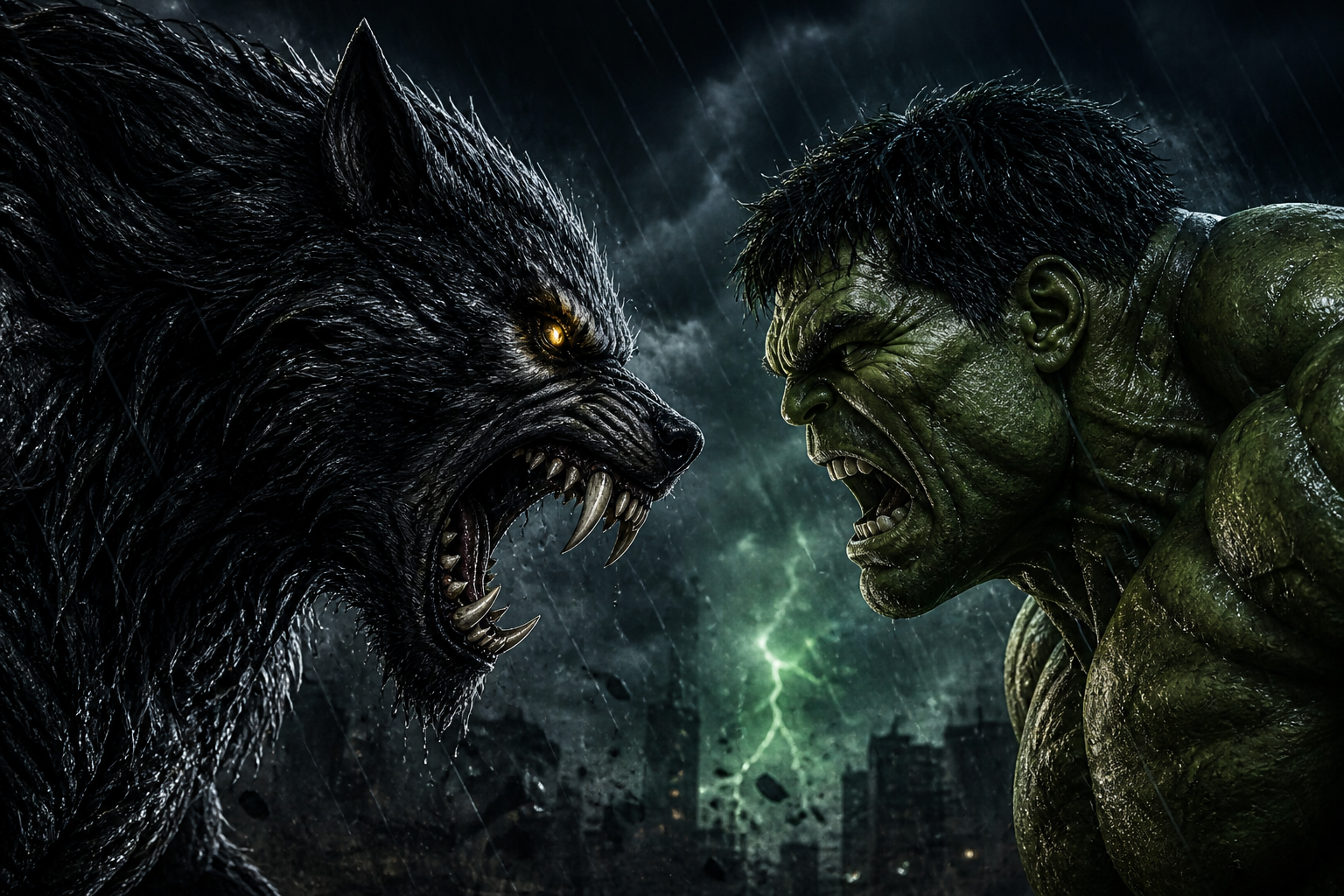
Previously on Hulk vs. Death Claw
The Helios Genomics facility didn’t appear on any public registry.
No permit filings with the Louisiana Department of Environmental Quality. No business license recorded with St. John the Baptist Parish. No digital footprint beyond a shell corporation registered in Delaware eighteen months ago under the name Helix Horizon Solutions, a name designed to disappear into search results rather than stand out from them.
The facility itself sat on twelve acres of private wetland, accessible by a single gravel road that branched off a parish maintenance route and ended at a security gate with no signage. The buildings were low and prefabricated, constructed fast, and designed to look abandoned from the air. Satellite dishes and ventilation units were mounted on the rooftops but painted flat gray to minimize reflection. The perimeter wire was subtle. The cameras were not.
Inside, the lights never went off.
Dr. Mark Bright arrived at the facility at six in the morning, the same time he arrived every day. He drove himself in a black SUV with tinted windows and parked in the same spot closest to the main entrance. Routine mattered to him. Routine was the difference between controlled science and chaos, and Bright had spent his entire career keeping those two things separated.
He was forty-four years old, lean in the way that came from forgetting to eat rather than exercising, with close-cropped gray hair. He holds a doctorate in molecular biology from Johns Hopkins and a second in genetic engineering from MIT. He’d spent eight years at a government contractor before a funding dispute ended his tenure and left him with a specific set of skills and a very specific resentment toward institutional oversight.
Helios Genomics had found him fourteen months ago. The offer had been direct. No bureaucracy. No ethics board. No ceiling.
Bright had accepted without negotiating.
He badged through the main entrance, nodded at the security desk, and walked down the central corridor toward the primary lab. The facility hummed around him, generators keeping the climate control steady, refrigeration units maintaining the sample storage at precise temperatures. He could hear the overnight team through the lab door before he opened it.
He pushed through and stopped.
Three technicians were clustered around the central workstation, their postures tight. The wall-mounted monitors displayed a cascade of data readouts, numbers scrolling faster than normal. One of the technicians, a young woman named Priya who ran the overnight shift, turned when she heard the door.
Her expression told him everything before she spoke.
“We had an event,” she said.
Bright walked to the workstation. “Define event.”
Priya pulled up the incident log on the nearest screen. “At 2:47 this morning, Dr. Kellner was running the hybrid compound trial. The LC-7 batch. He was attempting to stabilize the Lycan protein sequence using the modified energy catalyst we sourced last month.”
Bright looked at the log. “Kellner ran that trial alone?”
“He stayed after the shift change. He didn’t log it as an after-hours procedure.”
Bright’s jaw tightened. He kept his voice level. “Where is Kellner now?”
Priya hesitated. “Medical.”
“How bad?”
“Burns on his hands and forearms. The catalyst destabilized during the bonding process. The reaction produced a pressure event that compromised containment on the sample housing. The pulse vented through the lab exhaust before we could seal it.”
Bright straightened and looked at the ventilation schematic on the far monitor. The exhaust system ran from the primary lab through a scrubbing unit and discharged through roof vents. Standard protocol for biological containment. The scrubbing unit filtered particulates and most organic compounds.
It was not designed for energy discharge.
“How far did the pulse travel?” Bright asked.
Priya brought up the external sensor array. “We lost tracking at approximately four miles. The sensors aren’t calibrated for that type of output. We don’t know the full dispersal range.”
Bright studied the readout. The LC-7 compound was the most advanced iteration of the hybrid they’d developed so far. Six months of work building toward a stable fusion of the Lycan biological markers with the energy catalyst. The goal was a compound that could enhance the already extraordinary physical properties of an infected host to a level that made them viable as a controlled asset. Stronger. Faster. More durable. And unlike the naturally infected population in Bayou Mounds, it is responsive to external direction.
The weaponization component wasn’t Bright’s language. That framing came from the people who funded the facility, the ones he communicated with through encrypted channels and never met in person. Bright preferred to think of his work in terms of optimization. He was optimizing a biological system that already existed. The applications were someone else’s concern.
He looked at the damaged containment housing through the lab’s interior window. The casing was scorched, one panel blown outward. The sample inside had been LC-7 batch three, their most refined iteration.
“Is the sample recoverable?” he asked.
“Partially,” Priya said. “Maybe sixty percent of the compound survived intact. The rest degraded on discharge.”
Bright nodded slowly. Sixty percent was workable. They could reconstitute from the base components, though it would cost them two weeks minimum.
“Get Kellner’s statement before he leaves medical,” Bright said. “Full incident report on my desk by noon. And pull the external sensor logs. I want to know everything that pulse touched on its way out.”
Priya nodded and turned back to her workstation.
Bright walked to the interior window and looked at the scorched containment housing. The LC-7 compound had been months in development, built from blood samples sourced carefully and expensively from the Bayou Mounds infected population. The Lycan biology was extraordinary, the kind of raw material that didn’t exist anywhere else in documented science. The protein structures were unlike anything in standard genetic literature. The healing factors alone represented a decade of potential research.
And underneath all of it, the Death Claw strain.
Bright had read everything available on the Bayou Mounds outbreak. The public record was thin, the official narrative keeping the supernatural elements buried under language about environmental contamination and wildlife incidents. But Helios had better sources than the public record. They’d been watching Bayou Mounds for two years before establishing the facility. They knew what was out there.
They knew about Death Claw.
Bright turned away from the window and walked toward his office at the end of the corridor. He had calls to make and a timeline to reassess. Kellner’s unauthorized trial had cost them two weeks and an unknown quantity of dispersed compound. He’d deal with Kellner separately.
The larger concern was the pulse itself.
Four miles of confirmed dispersal, with an unknown range beyond that. The compound carried the Lycan biological signature. If that signature reached anything sensitive in the surrounding wetlands, the reaction was unpredictable. The Death Claw strain was documented to respond aggressively to foreign biological stimuli.
Bright sat down at his desk and opened his laptop.
He told himself the dispersal range was limited. He told himself the scrubbing unit had caught most of it. He told himself the wetlands were empty at three in the morning, and the pulse had dissipated harmlessly into dark water and cypress roots.
He was good at telling himself things.
Forty miles northwest, in a Bayou Mounds apartment, Derek Brown’s phone lit up the nightstand at 6:22 in the morning.
He was already half awake, the restlessness that came with his biology making deep sleep a negotiation rather than a certainty. He reached for the phone without sitting up and read the screen.
Olivia Hale. Text message.
Second livestock incident confirmed. Different property, same marsh perimeter. Chief Davis wants a briefing at 8. You available?
Derek sat up and typed back. I’ll be there.
He set the phone down and sat on the edge of the bed in the early morning quiet. His apartment was on the third floor of a building six blocks from the Lennox hub where he worked, a clean two-bedroom he kept orderly from long habit. The windows faced east. Gray light was starting to build outside.
He thought about the tree line from the night before. The broken fence rail. The chemical smell drifts out of the marsh.
He pulled up his contacts and found Dr. Carlos Marsh’s number. It was early, but Marsh kept odd hours and rarely complained about being called. Derek had learned that in the first month after the outbreak, when the questions came faster than the answers, Marsh had been the only person with enough background to help them understand what they were dealing with.
The call rang twice before Marsh picked up.
“Derek.” Marsh’s voice was alert, not groggy. Already awake.
“You hear anything about new operations in the wetlands?” Derek asked. “Private sector. Research-focused. Anything that shouldn’t be out there.”
A pause on the line. Longer than a simple no would take.
“Why?” Marsh asked.
“Two livestock incidents in two nights. The kill patterns are wrong for anything local. And there’s a chemical signature coming out of the marsh I can’t identify.”
Another pause.
“I haven’t heard anything specific,” Marsh said carefully. “But I’ve been picking up some noise through old contacts. DOD adjacent, private funding, nothing confirmed. Someone’s been sourcing biological samples from this region for at least a year. Quietly.”
Derek felt the information settle into the shape of the thing he’d already suspected. “Sourcing what kind of samples?”
“The kind you’d only want if you knew what was living out in those wetlands,” Marsh said.
Derek stood up and walked to the window. The sky outside was pale gray, the city below it still quiet.
“I’ll call you after the briefing,” Derek said.
He ended the call and stood at the window for a moment, looking southeast toward where the city gave way to the marsh. Somewhere out there, something had moved through those pastures with enough force to scatter cattle like they weighed nothing.
And somewhere beyond that, in the dark water and the cypress stands, whatever had made that chemical smell was still running.
Disclaimer Statement: The Incredible Hulk and all related characters are the property of Marvel Entertainment, LLC, a subsidiary of The Walt Disney Company. This story is an independently produced fan fiction created by Dee Watts. It is not affiliated with, endorsed by, or connected to Marvel Entertainment or any of its subsidiaries in any capacity. All Bayou Blood characters, locations, and story elements are original intellectual property owned exclusively by Dee Watts. This work was created for entertainment purposes only. No copyright infringement is intended.
Show Your Support
If you enjoy grounded, brutal werewolf storytelling, Bayou Blood is an ongoing serialized novel available exclusively on our Patreon.
New chapters drop regularly, along with bonus lore and behind-the-scenes content.
Step into the darkness here.



