
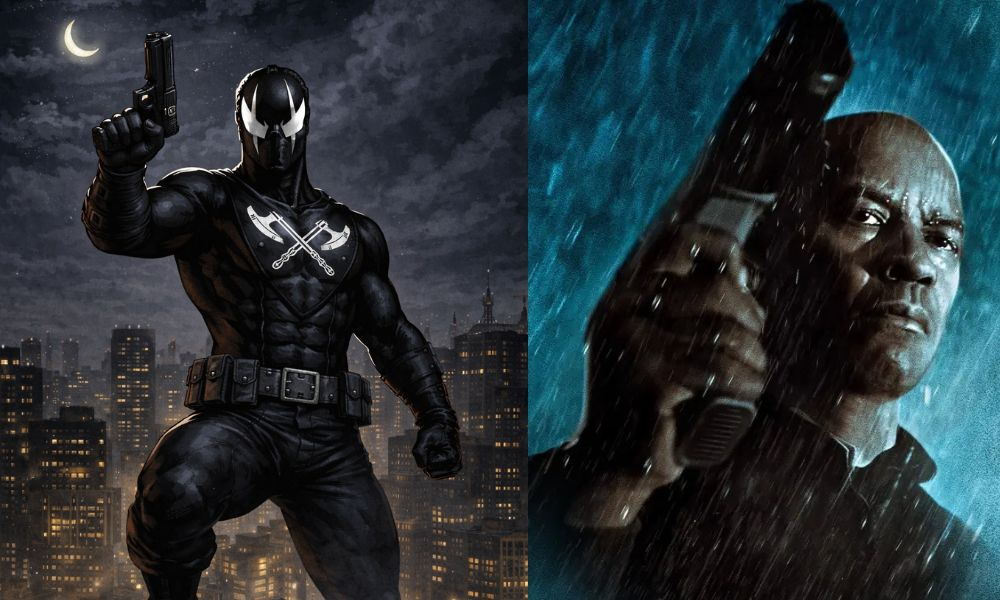
The vigilante genre has produced many memorable characters over the decades. From comic book icons to grounded cinematic heroes, the appeal of a lone individual confronting injustice continues to resonate with audiences. Two characters that embody this tradition in different ways are Devin Stone, the Black Ghost, and Robert McCall, the protagonist of the Equalizer franchise, portrayed by Denzel Washington.
At first glance, these characters exist in separate fictional spaces. One operates in the fictional city of Sumlin, Tennessee, while the other moves through recognizable American and international settings as a former intelligence operative. Yet when examined closely, the two worlds operate on remarkably parallel tracks. Their stories share structural themes, moral frameworks, and narrative mechanics that make them spiritually connected within the vigilante tradition.
The most obvious similarity between the two characters lies in their backgrounds as highly trained professionals who left structured systems behind. Robert McCall is a former intelligence operative who once worked in the shadows of government power. Devin Stone is a former Navy SEAL and electronic warfare specialist who spent years operating in elite military environments. Both men were trained by institutions designed to produce individuals capable of operating under extreme pressure and lethal circumstances. The difference is what happens after those careers end.
In both cases, retirement from those institutions does not remove the skills they developed. Instead, those skills become tools used in a new kind of mission. McCall uses his training to help vulnerable people who cannot rely on law enforcement or government systems. Devin Stone channels his training into a vigilante identity, the Black Ghost, operating within the fictional city of Sumlin. In both worlds, the protagonists represent a transition from institutional authority to independent justice.
Another major parallel is the motivation rooted in moral frustration with broken systems. McCall repeatedly encounters situations in which law enforcement, corporations, or criminal networks exploit people with little protection. The Equalizer stories often begin with McCall witnessing a person being abused or manipulated by powerful figures. The moment that injustice crosses a certain line, he intervenes.
A similar dynamic drives Devin Stone. Sumlin is portrayed as a city suffering from corruption, organized crime, and ineffective institutions. The justice system in his world has become stagnant, unable to confront the criminal networks operating in the shadows. Devin’s transformation into the Black Ghost stems from this frustration. When systems fail to protect citizens, both characters step forward as independent agents of accountability.
What makes these worlds feel parallel is that the protagonists do not operate as superheroes. Neither McCall nor the Black Ghost possesses supernatural powers. Their strength comes from experience, intelligence, and tactical skill. Both rely on preparation, planning, and controlled violence rather than spectacle. This grounded approach places their stories closer to crime thrillers than to traditional superhero narratives.
The tactical nature of both characters further reinforces the connection. Robert McCall is known for analyzing environments, identifying threats, and executing precise responses. His confrontations often unfold with meticulous timing and calculated movement. Similarly, Devin Stone’s combat style draws from elite military training. As the Black Ghost, he approaches situations with discipline and strategy, emphasizing efficiency rather than chaos. The fights in both worlds are less about brute force and more about controlled execution.
Another parallel emerges in the structure of the conflicts they face. The Equalizer films and stories often revolve around layered criminal networks. McCall may initially confront a single individual or group, only to discover that the situation connects to a larger organization. This escalation is a recurring narrative device.
The Black Ghost world follows a similar pattern. Devin Stone frequently uncovers deeper layers of corruption while pursuing criminals. What begins as a local incident can expand into a larger conspiracy involving corporate interests, organized crime, or political influence. These expanding threats allow the story arcs to grow in scale while maintaining a grounded starting point.
The environments in which both characters operate also share thematic similarities. McCall’s stories often highlight urban spaces where power imbalances thrive. Criminal groups exploit neighborhoods, trafficking networks prey on vulnerable people, and corrupt officials enable illegal operations. The city becomes a battlefield between exploitation and resistance.
Sumlin functions in much the same way. The fictional city is designed to reflect many of the same pressures found in real urban environments. Crime syndicates, corporate influence, and local corruption create a climate where ordinary citizens struggle to defend themselves. Within this environment, the Black Ghost emerges as a counterforce to that instability.
Another connection between the two worlds lies in the way the protagonists approach violence. Neither McCall nor Devin Stone seeks violence for its own sake. Their interventions usually occur after a situation crosses a moral threshold. Once that line is crossed, however, both characters demonstrate a willingness to use decisive force.
This moral structure is important because it separates them from traditional antiheroes who operate without ethical boundaries. McCall consistently frames his actions as protection for those who cannot defend themselves. Devin Stone follows a similar philosophy. The Black Ghost may operate outside the law, but his actions target individuals and organizations that have already caused significant harm.
The tone of the two worlds also contributes to their parallel nature. Both narratives blend crime thriller tension with vigilante justice. The stories are not centered on saving the world from cosmic threats or supervillains. Instead, they focus on grounded conflicts involving crime networks, corruption, and human greed. This tone creates a sense of realism, making both characters feel like extensions of the same storytelling tradition.
Another important similarity is the role of personal discipline and restraint. McCall lives a structured life built around routine, reading, and self-control. This disciplined lifestyle reflects his desire to maintain balance despite the violent actions he sometimes takes. Devin Stone similarly approaches life with structure. His background in elite military units and his leadership of Stone Defense Company reinforce the idea that he is not simply a vigilante operating on impulse. He is a professional applying discipline to chaotic situations.
Perhaps the most interesting parallel between the two worlds is the concept of quiet intervention. Neither McCall nor the Black Ghost seeks public recognition. They operate in shadows, allowing the outcomes of their actions to speak for themselves. Victims are protected, criminals are removed, and life continues without fanfare. This approach creates a mythic aura around both characters. They become urban legends in their respective environments.
For Robert McCall, that myth spreads through whispered stories about a man who appears when injustice becomes unbearable. For Devin Stone, the Black Ghost becomes a symbol moving through Sumlin’s criminal underworld, a presence that criminals fear but rarely see clearly.
Taken together, these similarities demonstrate why the worlds of the Black Ghost and Robert McCall can be viewed as parallel arcs within the broader vigilante genre. Both characters emerge from elite training backgrounds. Both are motivated by moral frustration with failing institutions. Both operate through strategy and discipline rather than superhuman power. And both inhabit environments where crime and corruption create a need for someone willing to intervene when official systems cannot.
The result is two characters who feel spiritually connected despite existing in separate fictional universes. Robert McCall represents the veteran intelligence operative who continues his mission after leaving the system. Devin Stone represents the former military professional who creates his own mission when the system no longer functions. Different settings, different stories, but driven by the same underlying idea: when justice fails, someone must step forward to restore balance.
That shared idea is what ultimately makes their worlds run parallel.
Vigilantism is a science, not a hobby.
At Strike 7 Network, we believe the best thrillers are built on tactical realism and high-stakes philosophy. The Black Ghost was created for the reader who wants more than just a masked hero—they want a soldier.
Our most ambitious arc yet, Rule of the Conductor, is now live for our Inner Circle members. Join our Patreon today to support independent noir and get immediate access to the next phase of the Ghost’s war.
Strike 7 Network on Patreon



