
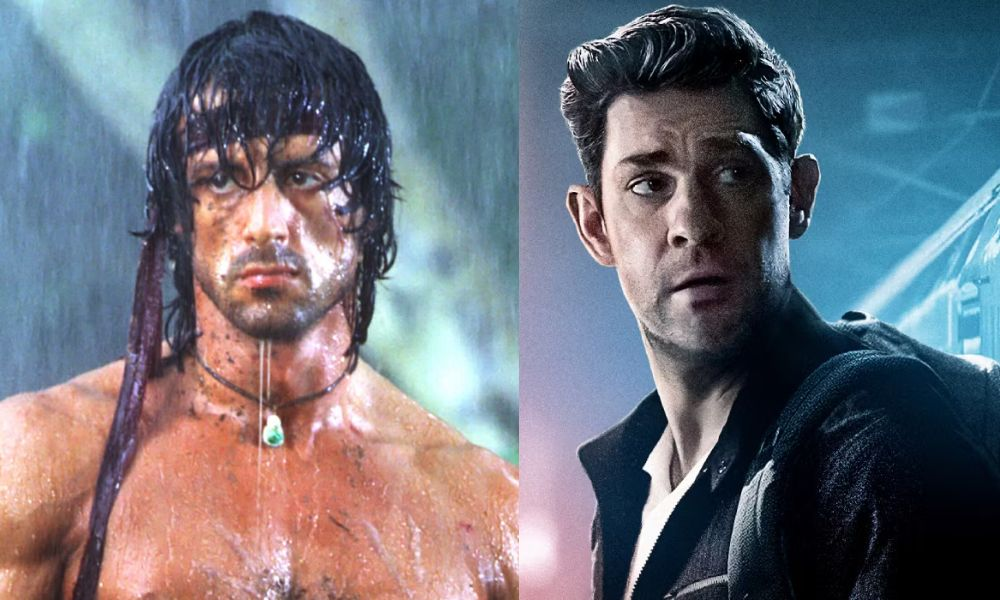
There are certain characters in the history of action fiction that transcend the specific stories they were created for and become something larger than any single film or novel can fully contain. Jack Ryan and John Rambo are two of those characters. One is a cerebral, morally grounded CIA analyst who became an unlikely hero through intelligence, courage, and an unshakeable commitment to doing what is right. The other is a decorated Special Forces veteran whose story is less about heroism in the traditional sense and more about the devastating cost of war on the human soul. Both characters have defined entire eras of action storytelling, and both carry the kind of depth, complexity, and cultural weight that the Marvel Cinematic Universe has always used as the foundation for its greatest additions. The question of which one belongs in the MCU is not as simple as it might first appear, and the honest answer, as we will explore here, is that both of them do.
Jack Ryan: The Analyst Who Became a Hero
Novelist Tom Clancy created Jack Ryan, who first appeared in the 1984 novel The Hunt for Red October. From his very first appearance, Ryan was designed as something different from the typical action hero. He was not a field operative built for combat. He was a historian, an academic, a former Marine whose bad back had taken him out of active service. He placed him behind a desk at the CIA, where his analytical mind became his most powerful weapon. Ryan’s origin is rooted in intellectual excellence rather than physical capability, and that distinction defines everything about who he is as a character.
What made Jack Ryan iconic was the combination of his brilliant analytical mind with a deeply ordinary moral compass. He is not trying to be a hero. He is trying to do the right thing in situations where the right thing is extraordinarily dangerous and deeply complicated. His character arc across Clancy’s novels and multiple film and television adaptations follows a man who is repeatedly pulled out of his comfort zone by circumstances that demand more of him than he ever planned to give, and who rises to meet those demands not through superhuman ability but through intelligence, moral clarity, and sheer refusal to back down.
His capabilities are formidable in a real-world sense. He is a trained Marine, a gifted analyst with an almost unparalleled ability to synthesize complex intelligence into actionable conclusions, a skilled tactician, and a man whose understanding of geopolitical systems and threats makes him one of the most valuable assets any intelligence organization could have. He is also, critically, a man of genuine conscience. Ryan does not operate in moral grey areas comfortably. He carries the weight of every decision he makes, and that psychological depth is what has kept him relevant across four decades of storytelling.
John Rambo: The Soldier the War Never Released
John Rambo’s origins could not be more different. Created by author David Morrell in the 1972 novel First Blood, Rambo is a former Green Beret and Vietnam War veteran who returns home from one of America’s most traumatic military conflicts to find that the country he fought for has no place for him. The original First Blood story is not primarily an action story. It is a tragedy about institutional abandonment, post-traumatic stress, and the way a society can create soldiers and then discard them when their usefulness is done.
What made Rambo iconic, particularly through Sylvester Stallone’s portrayal across multiple films, was the evolution of the character from a broken, hunted man in First Blood into something approaching a mythological figure in the sequels. Rambo’s capabilities in the field are extraordinary. He is a master of guerrilla warfare, wilderness survival, hand-to-hand combat, and improvised weapons. He can disappear into an environment and turn the natural world itself into a weapon against his enemies. His physical endurance and pain tolerance operate at a level that borders on superhuman, and his tactical instincts in the field are among the most lethal ever depicted in action cinema.
But underneath all of that capability is a man who never wanted to be a weapon. Rambo’s defining tragedy is that he was made into something the world now fears and does not know how to accommodate. His character arc is one of the most genuinely heartbreaking in action fiction, a man searching for peace in a world that keeps pulling him back into violence because it is the only language anyone speaks to him in.
Why Both Characters Deserve a Comic Book Universe
The argument for bringing both Jack Ryan and Rambo into comic book form, and specifically into the MCU’s narrative universe, is stronger than it might initially seem. Comic books as a medium have always been at their best when they take characters with genuine psychological depth and place them in situations that test that depth against extraordinary circumstances. Both Ryan and Rambo have that psychological depth in abundance.
Jack Ryan as a Marvel comic character would thrive as the MCU’s premier intelligence operative, a man whose role in the larger universe is not to punch threats into submission but to see them coming before anyone else does. His natural home in the MCU would be alongside organizations like S.H.I.E.L.D. or its successor structures, working in the space between government intelligence and superhero response. His enemies would be the kind of threats that do not announce themselves with explosions and alien invasions but with subtle geopolitical manipulation, the kind of villain that the Avengers would never see coming. Still, Ryan would identify a pattern of seemingly unrelated events weeks before the crisis point arrived.
In terms of MCU powers, Ryan would work best without any enhancement whatsoever. His superpower is his mind, and giving him a serum or a suit would undermine the very thing that makes him compelling. He is the baseline human who keeps up with extraordinary forces through sheer intelligence and preparation, which actually makes him a perfect complement to the more overtly powered characters in the Marvel universe. His most natural MCU faction alignment would be with the intelligence and espionage side of the universe, working alongside characters like Nick Fury, Maria Hill, and potentially the street-level operators of the Defenders universe when threats intersect with his intelligence work.
John Rambo in the MCU presents a different but equally compelling case. His skill set places him naturally in the same universe as characters like the Punisher and Daredevil, operators who exist in the morally complex space between hero and something harder to categorize. Rambo’s guerrilla warfare capabilities and his ability to operate alone in hostile environments against overwhelming odds would make him one of the most effective non-powered combatants in the Marvel universe. His psychological profile, the haunted veteran searching for purpose and peace, creates natural dramatic tension with virtually every superhero faction he might encounter.
In terms of powers, Rambo, like Ryan, works best without enhancement. His near superhuman endurance and pain tolerance can be explained within Marvel’s framework as the result of extreme Special Forces conditioning and battlefield hardening without needing a supernatural explanation. However, there is an interesting argument for a version of Rambo who has been exposed to a low-level variant of a super-soldier formula, not enough to make him Captain America, but enough to push his already extraordinary physical capabilities into territory that the MCU’s science could justify.
Rambo’s natural MCU faction is the Punisher’s world, the Defenders universe, and potentially a black ops division of whatever replaces S.H.I.E.L.D. His enemies would be military-industrial complex villains, corrupt government operatives, and the kind of organized criminal and paramilitary threats that require someone who understands warfare at the ground level rather than the superhero level.
Would They Have Their Own Comics or Appear in Existing Stories?
Both characters are strong enough to anchor their own standalone comic runs. A Jack Ryan Marvel comic that operates as an espionage thriller within the larger MCU framework, think a grounded geopolitical drama that occasionally intersects with the superhero world, would fill a genuine gap in Marvel’s current publishing lineup. A Rambo comic that explores John’s attempts to find peace while being repeatedly drawn back into conflict, this time against Marvel-caliber threats, could be one of the most emotionally powerful war comics the publisher has ever produced.
That said, both characters would gain enormous visibility and narrative richness from appearing in existing mainstream stories first before anchoring their own titles. Ryan showing up in a S.H.I.E.L.D.-centered story or a Captain America adjacent narrative would introduce him to Marvel’s existing readership in a context they already trust. Rambo crossing paths with the Punisher, arguably his closest Marvel equivalent in terms of psychological profile and moral complexity, would be one of the most natural and dramatically rich team-ups the MCU could produce.
The Verdict
Jack Ryan and Rambo represent two different but equally legitimate visions of what a non-powered hero can be in a universe full of extraordinary forces. Ryan brings intelligence, moral clarity, and geopolitical sophistication. Rambo brings raw tactical brilliance, emotional depth, and the kind of battlefield capability that no amount of superpower can fully replicate. The MCU is large enough and complex enough to hold both of them, and both of them are strong enough to enrich it. Calling this a tie is not a failure to choose. It is a recognition that the Marvel universe, at its best, has always been wide enough to contain multitudes.



