
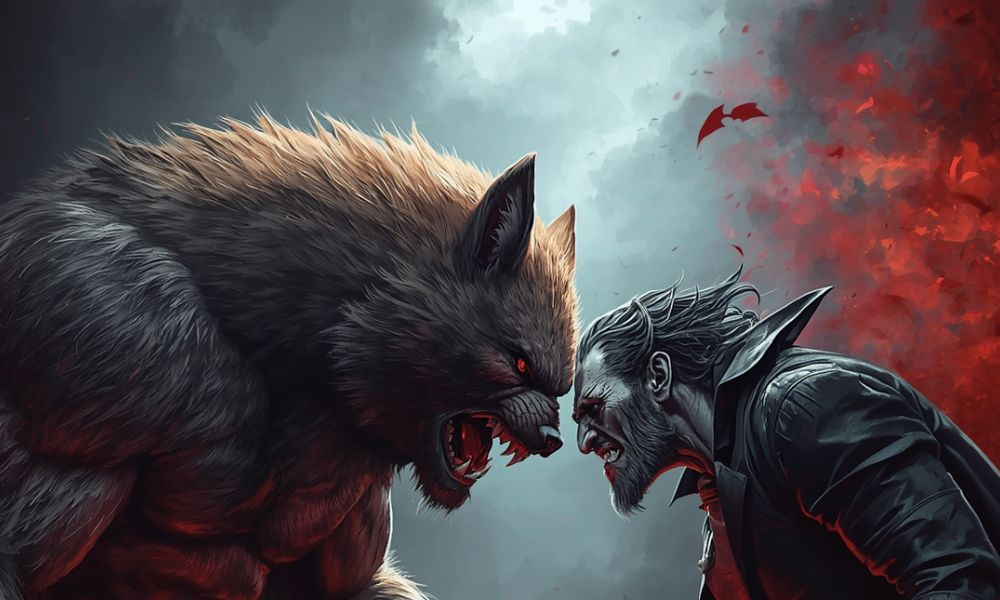
Some rivalries feel invented, manufactured for the sake of drama, and then some rivalries feel genuinely ancient, as though they were always going to exist. Storytellers simply discovered them rather than created them. The conflict between vampires and werewolves belongs firmly in the second category. It is one of the most enduring, viscerally satisfying conflicts in all of monster mythology, and it has shaped horror fiction, fantasy literature, and blockbuster cinema in ways that continue to reverberate through popular culture today. But the rivalry did not spring fully formed from the imagination of a Hollywood screenwriter. It has roots that run deep into folklore, religious history, and the shared mythological soil from which both creatures first emerged. Understanding where it came from requires going back much further than most people realize, and understanding why it has endured requires looking closely at what the Underworld franchise did with it at the turn of the twenty-first century.
The Shared Soil of Eastern European Folklore
The vampire and the werewolf are, at their deepest roots, creatures of the same cultural moment. Both emerged most powerfully from the folklore traditions of Eastern and Central Europe, particularly in regions like Romania, Bulgaria, Serbia, and the Slavic territories that would eventually become known as the cradle of vampire mythology. In these traditions, the boundary between the two creatures was not always as clean as modern fiction would suggest. There are documented historical cases, most notably the trial of Peter Stubbe in sixteenth-century Germany, in which a man was accused of being both a werewolf and a servant of dark supernatural forces in ways that blurred the line between lycanthropic and vampiric evil. The creatures shared a mythological neighborhood, and in that neighborhood, conflict was almost inevitable.
Part of what made them natural rivals rather than natural allies is the fundamental difference in their relationship to power and hierarchy. Vampire mythology, almost from its earliest recorded forms, is aristocratic in its architecture. The vampire is a lord, a master, a creature of refinement and command who operates from a position of domination over lesser beings. The werewolf, by contrast, is a creature of raw, uncontrollable nature. Where the vampire is cold and calculating, the werewolf is hot and feral. Where the vampire commands, the werewolf rages. These are not just different kinds of monsters. They represent different philosophical relationships to power, and that difference is the engine of every great vampire versus werewolf story ever told.
Related: Inside the Bayou Blood Universe: The Rise and Ruin of Project Death Claw
In some strands of Eastern European folklore, there is a direct mythological connection between the two creatures that already implies antagonism. Certain traditions held that a person who was a werewolf in life would become a vampire after death, a belief that created a kind of terrible continuity between the two states while simultaneously framing them as distinct and separate conditions. The werewolf was the living curse. The vampire was what the curse became when the body finally gave out. In that framework, the two creatures are not just different. They are sequential stages of the same damnation, and damnation has a way of turning inward.
Literary and Cinematic Groundwork
By the time the nineteenth century arrived and Gothic literature began codifying these creatures for a modern audience, the stage was already set for conflict. Bram Stoker’s Dracula, published in 1897, established the vampire as a figure of aristocratic menace and psychological domination. The wolves that appear in Stoker’s novel are under Dracula’s command, an early literary suggestion that the relationship between vampires and wolf-creatures was one of master and servant rather than equals. That hierarchical framing planted a seed that later storytellers would water extensively.
Throughout the twentieth century, horror cinema played with both creatures but rarely put them directly against each other in a sustained, narrative way. Universal’s classic monster films of the 1930s and 1940s gave both Dracula and the Wolf Man their iconic screen identities, but treated them largely as separate franchises. The Abbott and Costello crossover films of the late 1940s brought multiple monsters together, but in a comedic rather than mythologically serious context. The rivalry existed in the cultural imagination but had not yet been given the epic, operatic treatment it deserved.
Underworld and the Reframing of Everything
When Len Wiseman’s Underworld arrived in theaters in 2003, it did something that no film before it had managed to do with this particular conflict. It treated the war between vampires and werewolves, referred to throughout the franchise as Lycans, as a legitimate geopolitical epic. This was not a monster movie in the traditional sense. It was a war film dressed in leather and shadow, a story about ancient grudges, class warfare, betrayal, and the corrupting nature of power that happened to feature immortal creatures of the night as its protagonists.
The worldbuilding Underworld introduced was meticulous and genuinely ambitious. The Lycans were not wild, uncontrollable beasts in this telling. They were an enslaved class, warriors who had once served the vampire covens as protectors and guards, kept in a state of subjugation by vampire aristocracy for centuries. The rebellion led by Lucian, played with extraordinary conviction by Michael Sheen, reframed the entire conflict as something closer to a slave uprising than a simple monster war. The vampires were not just villains. They were colonizers, creatures who had built their power and comfort on the labor and suffering of beings they considered beneath them.
This was sophisticated storytelling for a genre film, and it resonated with audiences in ways that went beyond simple monster movie entertainment. The Lycan cause in Underworld carries genuine moral weight. When Lucian declares war on the vampire establishment, the audience understands why, and that understanding creates a complexity in the conflict that neither side can claim the simple high ground. Selene, the vampire Death Dealer played by Kate Beckinsale, begins the film as an instrument of that aristocratic power structure and spends the franchise slowly reckoning with what that means.
The franchise also did something visually and aesthetically transformative for both creatures. The vampires of Underworld were sleek, blue-tinted, corporate in their coldness, operating out of vast Gothic mansions that felt simultaneously ancient and modern. The Lycans were raw, industrial, survivalist, operating from the underground in every sense of the word. The visual contrast between the two factions told the story of the class war before a single line of dialogue was spoken. This was monster mythology as production design, and it influenced the entire aesthetic vocabulary of supernatural fiction that followed.
Show Your Support
If you enjoy grounded, brutal werewolf storytelling, Bayou Blood is an ongoing serialized novel available exclusively on our Patreon.
New chapters drop regularly, along with bonus lore and behind-the-scenes content.
Step into the darkness here.



